

Accurate Tank Level Monitoring
Know exactly how much water you have — without climbing to the terrace.
Almost every water problem in a building starts with a level nobody could see. A float switch jams and the tank overflows all night. A sump runs empty and the pump burns out. Level monitoring replaces the guesswork with a number — and because the same number drives the automation, the system acts on it before you have to.
Water level monitoring · ultrasonic level sensor · hydrostatic level transmitter · overflow alarm
Two ways to read a tank
Contact or non-contact — the tank decides, not the feature list. Both report to the same app and drive the same automation.
Non-contact
Ultrasonic level sensor
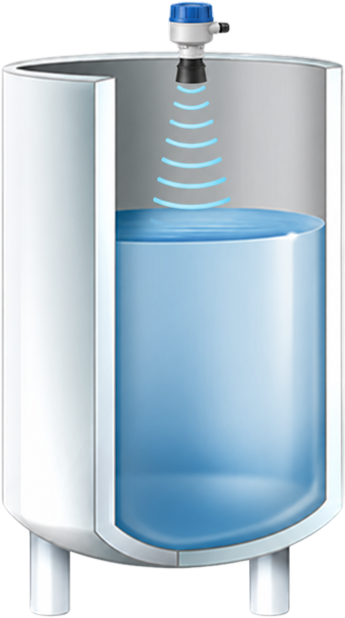
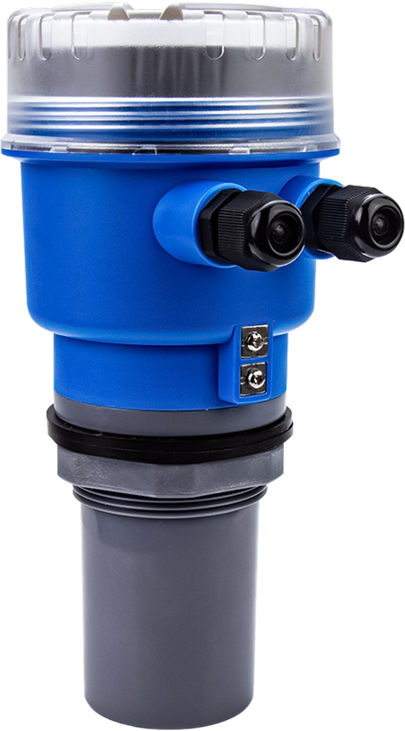
Mounts on the tank lid and pings the water surface, timing the echo to work out the level. It never touches the water — nothing to foul, nothing to corrode, and no probe to pull out and clean. The default choice for overhead and terrace tanks.
Best for: Overhead tanks · potable water · clean installations · tanks you would rather not open
Contact
Hydrostatic level transmitter
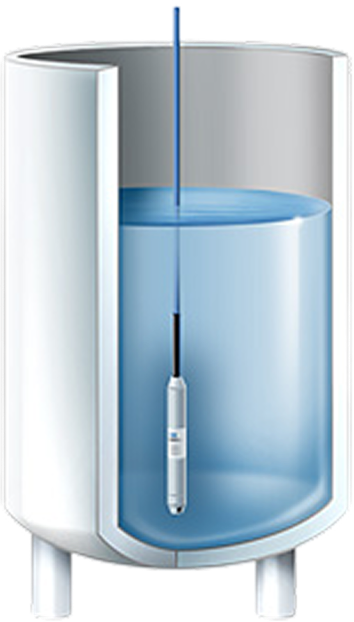
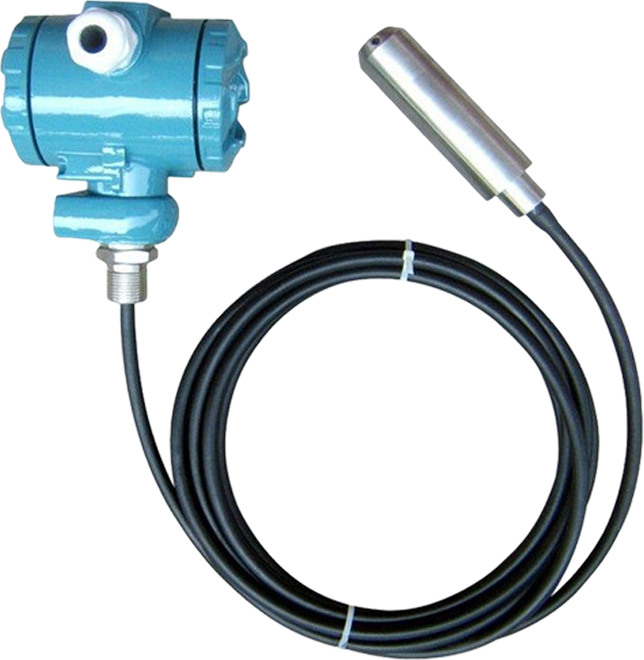
A sealed probe hangs on its cable near the tank floor and reads the pressure of the water column above it, which converts directly to depth. It sees through foam, turbulence and obstructions that scatter an ultrasonic echo, and it does not care how deep or how narrow the tank is.
Best for: Underground sumps · deep or narrow tanks · foaming or turbulent surfaces · borewells
How it is done
Every step below is a retrofit on the system you already have — no replacement pumps, no civil work.
- 1
Pick the sensor the tank deserves
Open, clean overhead tank on a terrace? Ultrasonic on the lid. Deep underground sump, a narrow neck, or a surface that churns while filling? A hydrostatic transmitter on a cable. We size it on the survey — most sites end up with a mix, and the app treats them identically.
- 2
Wire it to the controller
The sensor lands on the APCON smart driver in your pump room, wired or wireless depending on the run. Calibration is two numbers — empty and full — after which the controller converts every reading into percent and litres against your tank's real capacity.
- 3
Set the switching levels
Choose the level that starts the pump and the level that stops it, per tank. The controller enforces them locally, so overflow protection and dry-run protection keep working with the internet down and your phone in another city.
- 4
Watch it live, get told early
The app shows every tank live in percent and litres, plots the level through the day, and pushes an alert before a tank overflows or runs empty — not after.
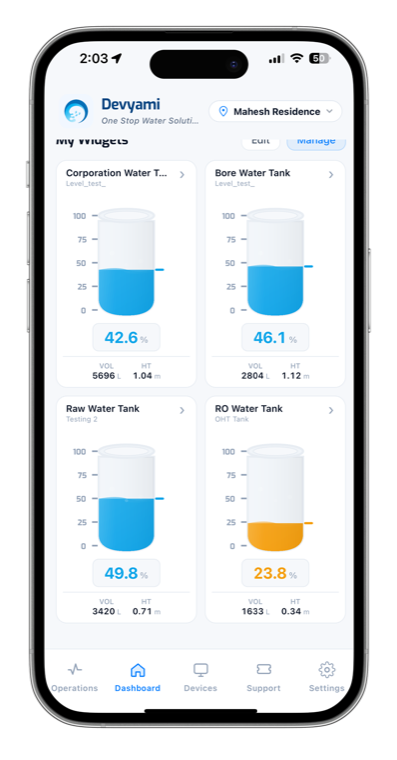
Live level, volume and height — every tank on one screen
Compatibility
Every tank on one system
Two tanks or ten, the levels belong to one controller. Which box you need depends only on how many tanks the same pump set has to keep full.
Source + destination
One controller, both tanks
Underground and overhead sensors land on the SAME APCON smart driver — contact or non-contact, in any combination. It reads both levels, decides when the transfer pump should run, protects the motor, and pushes both readings to the app. No separate gateway, and no second box for the second tank.
Many tanks, one pump set
Multi-level controller
Buildings rarely stop at two tanks: a sump, an overhead tank per wing, a flushing tank, a treated-water tank — often filled by the same pump set. The multi-level controller reads every one of those levels and sequences the pump between them. Fill this tank to its stop level, move to the next, skip whatever is already full, and stop the moment the source runs low.
- Ultrasonic (non-contact) and hydrostatic (contact) sensors, in any mix
- Underground sump AND overhead tank on a single controller
- Multi-level controller for several tanks sharing one pump set
- Per-tank start and stop levels, sequenced automatically
- Levels in percent, litres and metres — live on Android, iOS and web
- Source-and-destination logic: never fills from a sump that has run low
- Switching levels live in the controller, so they work with the internet down
Wireless add-on
No cable to the terrace
The hard part of sensing an overhead tank is almost never the sensor. It is the cable.
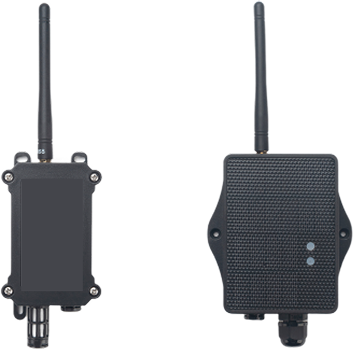
A sensor on the terrace normally needs a run all the way down to the pump room — through conduit, floor after floor. On a finished building that means drilling, chasing walls and the most disruptive day of the whole retrofit. The LoRa add-on removes that run: a radio module at the tank carries the reading to its pair at the APCON controller, so the only wiring left is short at both ends.
It is an add-on, not a different system. Same sensors, same controller, same screens in the app — the automation does not change, only how the reading gets downstairs.
- Replaces the long sensor cable between the pump room and the terrace
- An add-on to the APCON controller — same sensors, same app, same automation
- Long-range, low-power radio, suited to carrying one reading through a building
- Weatherproof enclosure and external antenna, for a rooftop installation
- No conduit between floors: no drilling, no chasing walls, no false ceiling work
- Useful anywhere a cable run is awkward — remote sumps and borewells too
What it takes
- Ultrasonic level sensor (non-contact) or hydrostatic level transmitter (contact)
- APCON smart motor driver — reads the sensor, switches the pump, protects the motor
- The Devyami app on Android, iOS or any browser
What you get
- No overflow — the pump stops at the level you set, every time
- No dry run — a tank that cannot feed the pump stops the pump
- Level in percent AND litres, against the tank's real capacity
- A day's level trend that shows consumption and exposes overnight leaks
Questions, answered
Ultrasonic or hydrostatic — which sensor should I use? +
Ultrasonic for clean, accessible tanks where nothing should touch the water: terrace and overhead tanks are its home ground. A hydrostatic level transmitter for underground sumps, deep or narrow tanks, and any surface that foams or churns while filling — it reads the water column pressure, so a disturbed surface does not confuse it. Both report to the same app and drive the same automation; the choice is about the tank, not the features.
Can I retrofit level sensors to tanks I already have? +
Yes. An ultrasonic sensor mounts on the existing lid and a hydrostatic transmitter simply hangs into the tank on its cable — no tank modification, no draining, no civil work. Retrofit is the normal case.
Do level sensors work if the internet goes down? +
Yes. The sensor talks to the APCON controller in your pump room, and the switching levels live inside that controller. The internet only carries the view and the alerts to your phone — it is never in the loop that protects your motor or your ceiling.
The rest of the system
Every capability runs on the same controllers, the same app and the same live data.
Digital Flow Monitoring & Water Metering
Digital flow meters turn every pipeline into a number you can manage: litres pumped today, consumption per wing or per site, and totals you can export. Water metering is also your leak detector — flow at 3 AM when everyone is asleep is a leak announcing itself.
How it is done →Hot Water Circulation
A monitored circulation loop keeps hot water at every tap the moment it opens — no running the shower cold for a minute. The app watches loop temperature, runs the circulation pump only when needed, and coordinates heat pumps and geysers so comfort never fights efficiency.
How it is done →Pump Status, Control & Protection
Every pump shows its truth in the app: running or stopped, current, voltage and run hours — and a Start/Stop that works from anywhere. Underneath, the APCON motor driver protects against dry run, overload, phase failure and voltage faults, whether or not your phone is in the room.
How it is done →HPN & Multi-Pump Pressure Systems
Hydro-pneumatic (HPN) systems keep constant pressure across a whole building: pumps cascade in as demand rises, rotate duty so they wear evenly, and stand by for each other. A pressure transmitter on the header puts live line pressure in the app — lead/lag status, pressure trends and every changeover.
How it is done →Timer & Scheduler — Irrigation & Fountains
Garden irrigation, landscape zones and fountains run to a schedule you set once from your phone: start time, run duration, which days, which zone. The controller keeps time locally, skips a cycle when the tank is too low to spare the water, and logs every run.
How it is done →Want accurate tank level monitoring on your site?
Tell us what your pump room looks like today — we design, retrofit and stand behind the whole system.