

Water Treatment
Treatment matched to your water report.
Source water in most Indian cities is a lottery — hardness in one borewell, sediment in the next, bacteria after the monsoon, salts in a tanker. Treatment is about matching the right stages to your actual water report: filters for particles and odour, a softener for hardness, ultrafiltration for microbes, RO where dissolved solids demand it. And for the water that leaves the building, an STP or an ETP. We design treatment trains, we don’t just sell cartridges.
Start with the water report
What you see, what causes it, what fixes it
| What you see | The cause | The treatment |
|---|---|---|
| Scale on taps, white spots, geysers failing | Hardness | Water softener → |
| Muddy or silty water, sediment in the tank | Turbidity, suspended solids | Sand filter → |
| Smell, colour or a chlorine taste | Chlorine, organics | Activated carbon filter → |
| Bacteria after the monsoon, cloudy water | Microbes, colloids | Ultrafiltration → |
| Salty or brackish taste, high TDS | Dissolved salts | RO → |
| Sewage from the building | Organic load | STP → |
| Effluent from a process | Industrial contaminants | ETP → |
Clean water in
Treating the water you use
Water Softeners
- Takes out
- Hardness — the calcium and magnesium behind scale, white spots, stiff laundry and failing geysers and heat pumps.
- How
- Ion-exchange resin swaps the hardness for sodium; when the resin is spent, the softener regenerates itself with salt brine.
- Where it is used
- Homes, apartments, hotels, laundries, boiler and cooling-tower feed
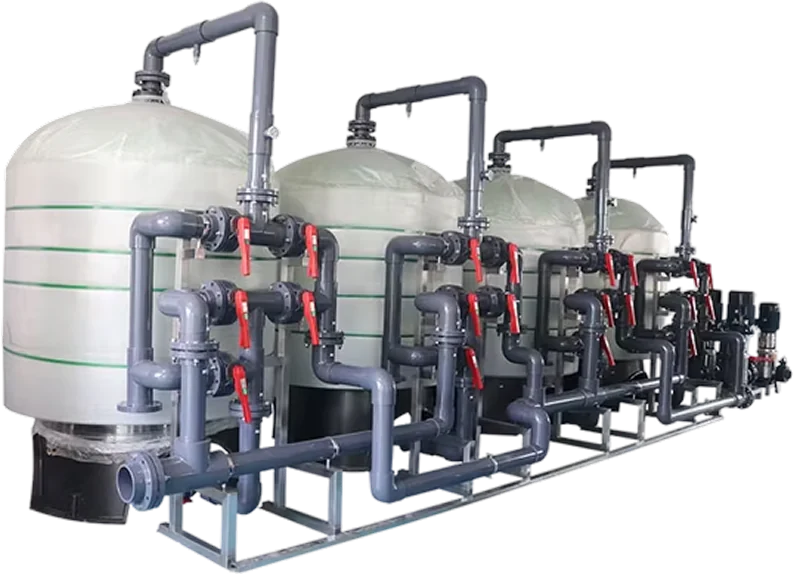
Sand & Carbon Filters
- Takes out
- Sand: silt, sediment and turbidity. Activated carbon: chlorine, odour, colour and organic matter.
- How
- Water passes down through graded media beds; the filter backwashes itself to flush out what it has caught.
- Where it is used
- The first stage on borewell and tanker water — and protection for the softener or RO after it
Ultrafiltration (UF)
- Takes out
- Suspended particles, colloids and bacteria — while the water keeps its dissolved minerals.
- How
- Hollow-fibre membranes with pores far finer than a sand filter’s, working at low pressure with little reject water.
- Where it is used
- Safe water where TDS is already fine, and pre-treatment ahead of an RO plant
Industrial RO Skid Systems
- Takes out
- Dissolved salts (TDS) — the brackish, salty taste no filter can touch.
- How
- A high-pressure pump pushes water through semi-permeable membranes, all pre-assembled on one skid with its instruments.
- Where it is used
- Process water, boiler feed, packaged drinking water, high-TDS borewells
Clean water out
Treating the water that leaves
Sewage Treatment Plants (STP)
- Takes out
- The organic load in a building’s sewage.
- How
- Biological treatment followed by settling, filtration and disinfection, so the treated water can be used again.
- Where it is used
- Apartments, hotels, hospitals and campuses — reusing water for flushing, gardening and cooling
Effluent Treatment Plants (ETP)
- Takes out
- The contaminants in industrial effluent, which differ from one process to the next.
- How
- Physical, chemical and biological stages designed around the effluent’s own analysis.
- Where it is used
- Factories and process industries — to meet discharge norms or reuse the water
A treatment train
Each stage protects the next
A typical sequence for difficult water. Not every site needs every stage — the water report decides which ones yours does.
- Raw water
- Sand filter
- Carbon filter
- Softener
- Ultrafiltration
- RO
- Treated water
See the plant in the app
Raw, treated and reject TDS, pH and ORP, pressures and every pump trip — live from the RO plant.
Products
Products that achieve this
Water treatment, answered
Do I need a softener or an RO? +
It depends on the water report. A softener removes hardness — calcium and magnesium — which causes scale; the water’s total dissolved solids stay much the same. An RO removes dissolved salts, so it is the answer to high TDS or a salty taste. Many sites need a softener for the whole building and an RO only for drinking or process water.
What is the difference between a sand filter and a carbon filter? +
A sand filter catches particles — silt, sediment and turbidity. An activated carbon filter adsorbs dissolved things a sand filter cannot hold: chlorine, odour, colour and organic matter. They usually work as a pair, sand first.
How is ultrafiltration different from RO? +
UF stops particles, colloids and bacteria but lets dissolved minerals through, works at low pressure and wastes little water. RO also removes dissolved salts, needs a high-pressure pump and produces a reject stream. UF is often used before an RO to protect its membranes.
Does my building need an STP? +
Larger residential and commercial buildings are often required by local regulations to treat their own sewage — check with your local authority. Beyond compliance, treated water reused for flushing and gardening cuts the fresh water a building has to buy. We size the plant to the occupancy and the norms that apply.
What is an ETP? +
An effluent treatment plant treats the wastewater from an industrial process before it is discharged or reused. Because every process produces different effluent, an ETP is designed from the effluent’s own analysis, combining physical, chemical and biological stages.
Send us your water report
Or tell us where your water comes from — we design the treatment train, install it and stand behind it.