

Remote Pump Monitoring & Control
Switch it from anywhere — and know why it stopped.
A pump is the most expensive thing in a pump room and the least observed. It trips at 2 AM and nobody knows until the tank is empty; it wears out for weeks and nobody sees it coming. On an APCON controller every pump reports to the Devyami app — what it is doing, what it last did and why, and the numbers that say it is ageing — with a Start/Stop that works wherever you are.
Pump monitoring · remote pump control · pump fault alerts · run hours · pump monitoring app
What makes it work
The parts of the diagram above that are doing the real work.
Every trip, with its reason
When a protection acts, the app shows which one and when — dry run, overload, voltage or phase — and the event log keeps it. The protections themselves run inside the controller; the motor protection page covers all nine.
Control from anywhere
Start and stop from the app wherever you are, with live current, voltage and run hours while it works. The same numbers your service team reads, so most faults are diagnosed before anyone visits the pump room.
Numbers that predict a failure
Run hours and start counts per pump, with current and voltage trends, show a pump wearing out weeks before it fails — so service becomes planned maintenance instead of an emergency.
What you see, and what you can change
Monitoring sits on top of the automation and the protection — it never sits inside them.
- Pump state — running, stopped, tripped — with the reason attached
- Voltage, current, power factor and true power on every phase, while the motor works
- Run hours and start counts per pump, the two numbers that predict a failure
- Push alerts the moment a protection trips, plus device-offline and power-failure notices
- A time-stamped event log of every switch, trip, changeover and setpoint change
- Start / stop, auto / manual, setpoints and schedules changed from anywhere
- Over-the-air firmware updates, so a controller improves after it is installed
- RS485 Modbus RTU on the controller, for sites that also want the pumps in a SCADA, PLC or BMS
How it is done
Every step below is a retrofit on the system you already have — no replacement pumps, no civil work.
- 1
Replace the starter with the driver
The APCON driver takes your old starter panel's place on the wall — starter, controller and monitoring in one box. Your pump, plumbing and wiring stay exactly as they are.
- 2
Connect it to the app
Put the controller on Wi-Fi and every pump appears in the Devyami app and web portal, live — state, current, voltage and run hours.
- 3
Set your alerts
Trips, power failure and the controller going offline reach your phone the moment they happen, each trip with its cause attached.
- 4
Control and review from anywhere
Start and stop from anywhere, watch the electricals while it runs, and read run-hour history that tells you a bearing is going weeks before it goes.
What it takes
- APCON Motor Driver — single or three phase — or a Twin Motor Driver or Multi Pump Controller
- Wi-Fi at the pump room
- The Devyami app and web portal for control, live electricals, alerts and history
What you get
- Start/Stop from anywhere — no trip to the pump room
- Every trip reported the moment it happens, with its cause
- Current and voltage trends that warn you a motor is wearing out
- Run hours and start counts per pump, for planned maintenance instead of emergencies
Controllers that do this
Engineered and built by us — each one the starter, the controller and the protection in a single box.
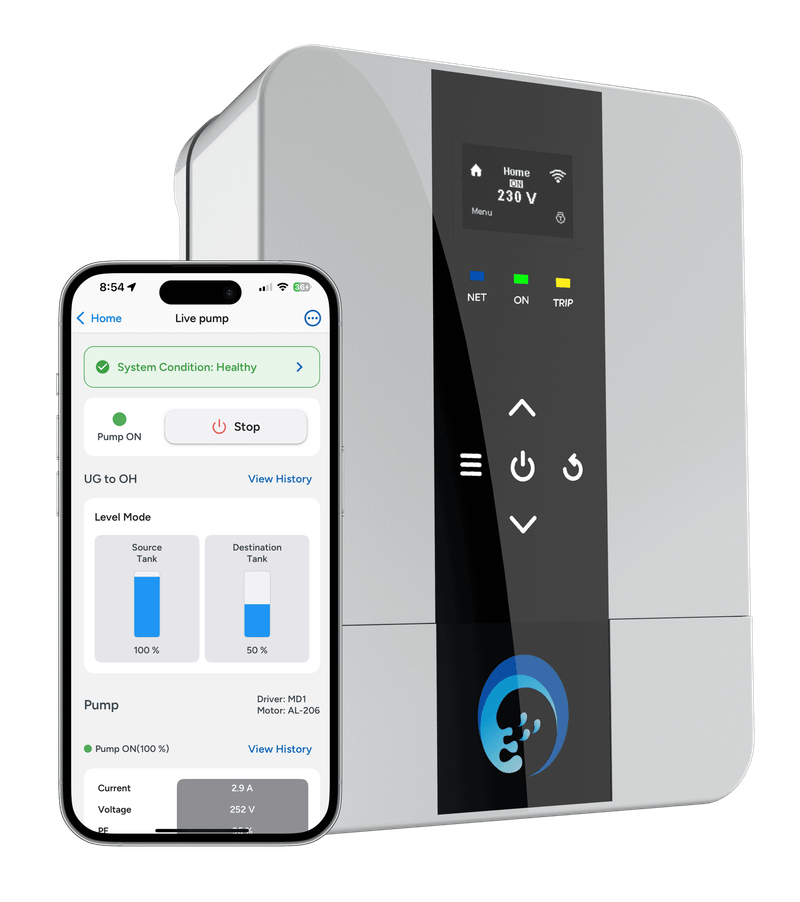
Motor Driver
Starter, controller and motor protection for one pump — single or three phase.
View product →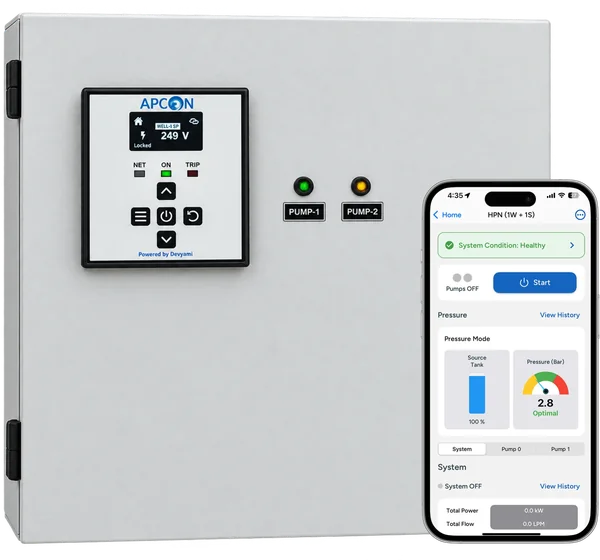
Twin Motor Driver
Two pumps from one controller — duty shared, each motor protected on its own.
View product →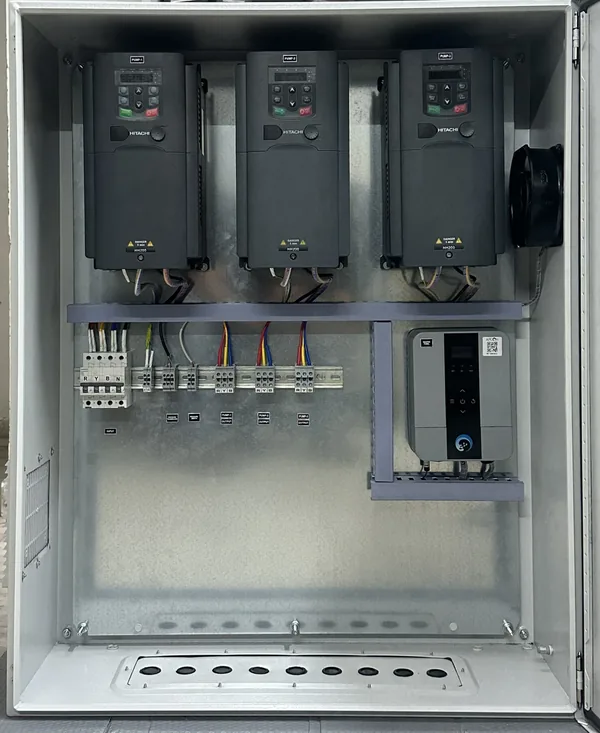
Multi Pump Controller
Up to six pumps — drives and direct-on-line — running as one system.
View product →Questions, answered
Do I still need a separate starter panel? +
No. The APCON driver IS the starter — it replaces that panel and adds the controller and the monitoring in the same box. That is what makes it a retrofit rather than an addition.
What alerts will I get? +
A push alert the moment a protection trips, with the reason — dry run, overload, voltage or phase — plus power-failure and device-offline notices. Every one is also kept in the time-stamped event log.
What happens if the internet fails? +
The pump keeps running and stays protected — the automation and every protection run inside the controller on the wall. The app loses its live view until the connection returns; the cloud is never part of the decision to cut power to a motor in trouble.
The rest of the system
Every capability runs on the same controllers, the same app and the same live data.
Smart tank monitoring & automation
Two ways to read a tank — non-contact ultrasonic on the lid, or a contact hydrostatic level transmitter hanging in the water. Both report live percent and litres, warn you before an overflow or an empty tank, and feed the same reading the controller switches your pumps on.
How it is done →Pressure monitoring
Hydro-pneumatic (HPN) systems keep constant pressure across a whole building: pumps cascade in as demand rises, each start goes to the pump with the fewest starts so the set wears evenly, and a pump that trips is covered by the next. A pressure transmitter on the header puts live line pressure in the app — which pumps are running, pressure trends and every changeover.
How it is done →Temperature & heat pump monitoring
A monitored circulation loop keeps hot water at every tap the moment it opens — no running the shower cold for a minute. The app watches loop temperature, runs the circulation pump only when needed, and coordinates heat pumps and geysers so comfort never fights efficiency.
How it is done →Water quality & RO monitoring
The RO plant’s own numbers on your phone: raw, treated and reject TDS, pH and ORP, flows, the pressures either side of the membrane, and every pump, switch and tank float — with an alert the moment something trips.
How it is done →Water metering & batching
Digital flow meters turn every pipeline into a number you can manage: litres pumped today, consumption per wing or per site, and totals you can export. Water metering is also your leak detector — flow at 3 AM when everyone is asleep is a leak announcing itself.
How it is done →Timers & schedules
Garden irrigation, landscape zones and fountains run to a schedule you set once from your phone: start time, run duration, which days, which zone. The controller keeps time locally, skips a cycle when the tank is too low to spare the water, and logs every run.
How it is done →More in Water Automation & Controls
Want remote pump monitoring & control on your site?
Tell us what your pump room looks like today — we design, retrofit and stand behind the whole system.