

Pump Motor Protection
Nine faults that kill pump motors — each one caught in the controller, before the damage.
Most pump motors do not wear out — they are killed. Run dry until the seal goes, run on two phases until the winding cooks, or started forty times an hour by a float that sticks. Every APCON controller watches the motor and the supply on every phase, cuts the power in time, and then tells you which fault it was.
Dry run protection · motor protection · overload protection · single phasing preventer · under voltage protection
What makes it work
The parts of the diagram above that are doing the real work.
It watches power, not just current
When a pump loses water its current barely moves — the power factor is what collapses. Measuring true power on every phase is how the controller sees a dry run with no sensor in the tank at all.
Decided in the controller
Every protection runs on the controller's own processor. No internet, no app and no phone is part of the decision to cut power to a motor in trouble.
It tells you what it was
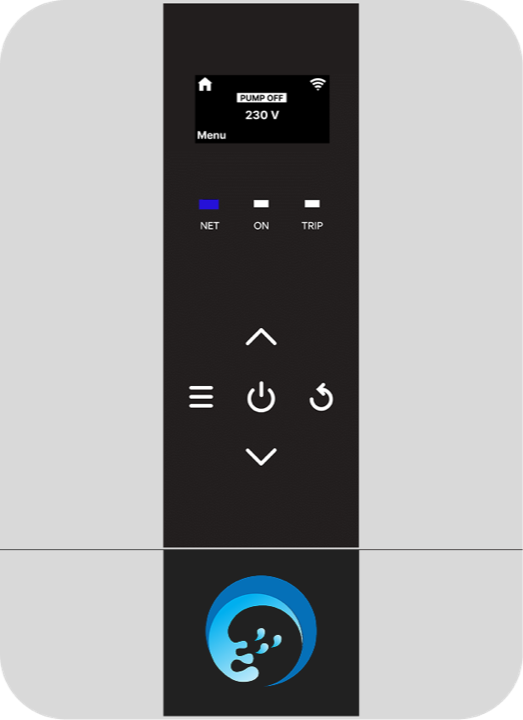
Each trip is named on the panel, logged with its cause and time, and pushed to the app — so a dry morning comes with a reason attached.
The nine protections
Armed on every pump, decided inside the controller, and logged with their cause the moment they act. The numbers are factory defaults — each is set to the pump at commissioning.
Dry run
Power-based · no sensor
Watches
True input power — trips below half the pump's rated power, held for 5 seconds (default)
When a pump loses water its current barely moves — the power factor is what collapses, so real input power drops hard and unmistakably. That is why power-based detection trips where a current-only relay dithers. No sensor in the tank: the whole detection happens at the panel.
Dry run
Sensor-based
Watches
The water itself — a float, conductive probe or level transmitter at the source
Definitive, and earlier: it stops the pump before it has ever run dry, rather than after the electricals notice. On borewells and sumps that empty daily both methods run together — the sensor as the plan, the power signature as the backstop for the day a probe fouls or a cable is cut.
OL
Overload
Watches
Current on a thermal curve, tripping at 1.2× the maximum you set — so a healthy start is never a trip
A jammed impeller, a seizing bearing, mechanical binding, or a motor asked for more than its rating. Winding insulation is a temperature story with no undo — cutting in time is what keeps a rewind from becoming an annual event.
UL
Under load
Watches
Running current below the minimum set for this pump
The motor is turning but the pump has nothing to push — it has lost suction, the foot valve is passing, the delivery is shut or the coupling has sheared. An unloaded pump is usually a pump about to be damaged: the mechanical seal goes first, in minutes rather than hours.
UV
Under voltage
Watches
Each phase below 185 V for 5 seconds (default)
A motor asked for the same torque at a lower voltage draws more current and runs hotter for it. Brownouts kill more motors than surges do, and they do it quietly — the pump keeps working right up until the winding gives out.
OV
Over voltage
Watches
Each phase above 285 V for 5 seconds (default)
Insulation stress on the winding and cooked electronics downstream. It arrives when a big load is shed on the street, on a generator changeover or on a poorly regulated supply — and the damage adds up long before anything trips visibly.
Phase
Phase loss, weak phase & reversal
Watches
All three phases — presence, strength and sequence (3Φ controllers)
Lose one phase on a running three-phase motor and the other two carry roughly 1.7 to 2 times their current: the winding cooks in minutes. The controller also watches for a weak phase and for phase sequence — a submersible running backwards delivers almost nothing while looking perfectly healthy.
Over cycle
Starts per hour
Watches
Starts in a rolling hour — 150 by default, set to suit the pump
Hunting — a jammed float, a leaking foot valve, a waterlogged pressure vessel, a dead band set too narrow. Every start is where a motor takes its inrush and its heat, so a pump starting forty times an hour is being destroyed by starting. The trip saves the motor; the alert points at what is broken upstream.
Over run
Maximum run time
Watches
Continuous run time — 6 hours by default, set to the longest legitimate cycle
A tank that never reaches its stop level means a leak, a valve left open, or a level sensor that has stopped reporting. This is the protection that catches the expensive failure — the pump that ran all night into a burst line.
What happens after a trip
A protection that only cuts power is half a protection. The controller also decides whether the fault was a passing supply dip or a real failure — and says which one it thought it was.
- Automatic retry after a delay — two attempts, four minutes apart, by default
- Lockout after the retries, so a real fault is never hidden by a hopeful restart
- The retry count clears after fifteen healthy minutes
- Voltage and phase faults restore themselves once the supply is back in the window
- Every trip logged with its cause and a time stamp — on the panel and in the app
- Reset at the keypad or remotely, once you know what actually happened
How it is done
Every step below is a retrofit on the system you already have — no replacement pumps, no civil work.
- 1
The controller replaces the starter
The APCON driver takes the old starter panel's place on the wall, so the protection sits in the same box that switches the motor — not in a relay bolted on beside it.
- 2
Limits are set to the pump
Maximum and minimum current, rated power and the voltage window are set to the motor on site. The factory defaults are a safe start, not a guess about your pump.
- 3
Every phase, all the time
Voltage, current, power factor and true power are measured on every phase while the motor runs — and the level sensors, where fitted, are watched alongside.
- 4
A trip arrives with its reason
The panel names the fault, the event log records it, and the app pushes it to your phone — so the service visit starts with a diagnosis.
What it takes
- Motor Driver (1Φ or 3Φ), Twin Motor Driver or Multi Pump Controller
- Optional: a level sensor at the source for sensor-based dry run
- Optional: the Devyami app for trip alerts and the event log — protection works without it
What you get
- Dry runs stopped before the seal or impeller is damaged
- No motor burnt on two phases or in a brownout
- Hunting pumps caught by their start count
- Every trip with its cause — diagnosis without a site visit
Controllers that do this
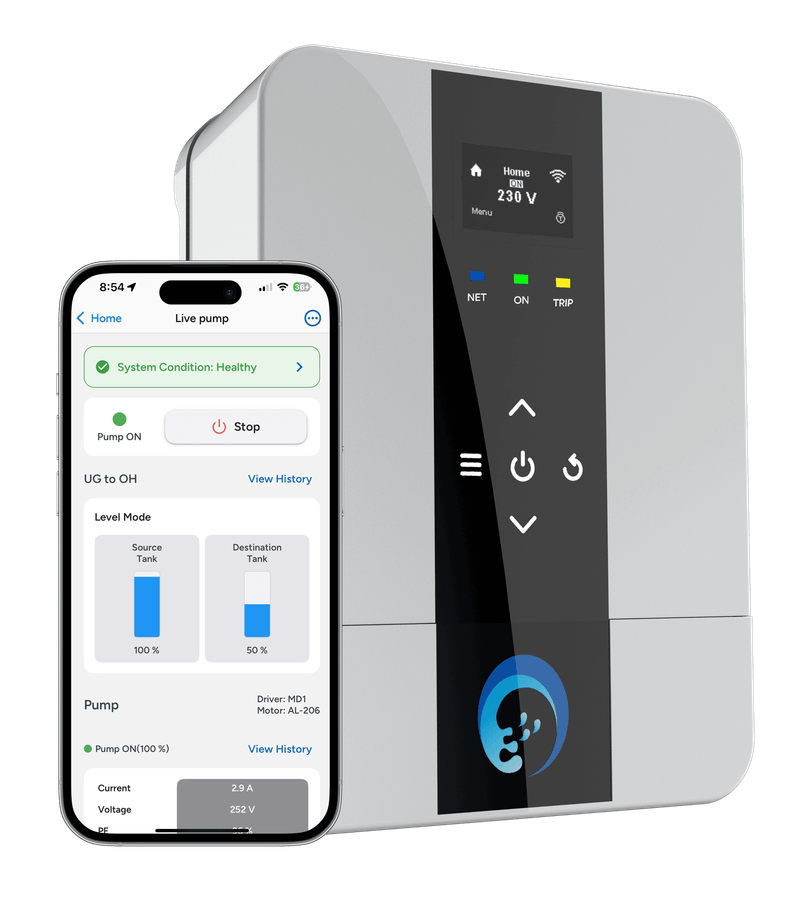
Engineered and built by us — each one the starter, the controller and the protection in a single box.
Motor Driver
Starter, controller and motor protection for one pump — single or three phase.
View product →Twin Motor Driver
Two pumps from one controller — duty shared, each motor protected on its own.
View product →Multi Pump Controller
Up to six pumps — drives and direct-on-line — running as one system.
View product →Questions, answered
What is the difference between power-based and sensor-based dry run protection? +
Sensor-based dry run watches the water: a float, conductive probe or level transmitter at the source. It is definitive and acts before the pump has ever run dry. Power-based dry run watches the motor instead — when a pump loses water its current barely changes but the power factor collapses, so true input power drops sharply. That needs no sensor in the tank at all. On borewells and sumps that empty daily we normally run both.
Why does over-cycle protection matter if the pump is switching correctly? +
Because every start is where a motor takes its inrush and its heat. A pump that starts forty times an hour is being destroyed by starting, and the cycling itself is a symptom — a jammed float, a leaking foot valve, a waterlogged pressure vessel, or a dead band set too narrow. Over-cycle protection cuts the motor to save it, and the alert points you at the cause.
Does motor protection need the internet? +
No. Every protection runs inside the controller on the wall. The internet only carries the alert and the event log to your phone — it is never part of the decision to cut power to a motor in trouble.
More water automation
Every automation runs on the same APCON controllers — and keeps working without the internet.
Multi-Pump Systems & Duty Rotation
Run two to six pumps as one set: duty rotates so they wear evenly, extra pumps stage in when demand rises, and a healthy pump takes over the moment one trips.
How it is done →Pump Starters — DOL, Star–Delta & VFD
DOL, star–delta or a variable frequency drive: how each one starts a pump motor, the starting current it draws, and which one your pump needs — with automation and protection on top of every one.
How it is done →Also automated
Want pump motor protection on your site?
Tell us what your pump room looks like today — we design, retrofit and stand behind the whole system.