

Pump Starters — DOL, Star–Delta & VFD
The motor and the supply choose the starter — and the starting current shows why.
Under every automation there is a starter making the motor turn. Which one you need depends on the motor's size, the load it starts against and what your electricity supplier allows — not on a feature list. The chart above is the whole argument: how many times its full-load current a motor pulls while it gets up to speed.
DOL starter · star delta starter · VFD for pumps · soft start · pump control panel
The three ways to start a pump
Inside the panel on top, the starting current underneath — on one shared scale, so “six to eight times full load” is a height you can see.
DOL — Direct On Line
Full voltage, straight to the motor.
The motor sees the full supply from standstill. It is the simplest, cheapest and most robust way to start a pump, with the fewest parts that can fail — and the right answer for most transfer, level and circulation duties, where a short inrush on a small motor bothers nobody.
- Starting current
- 6–8 × full load
- Starting torque
- 100%
- Typical range
- Up to ~7.5 kW / 10 HP
- Speed control
- None — one speed
Best for: Level and transfer pumps, boosters, circulation duties, and anything the supply authority allows to start direct.
Star–Delta
Start in star to get moving, change to delta to run.
In star, each winding sees about 58% of line voltage, which draws roughly a third of the DOL inrush — and gives roughly a third of the torque. Near full speed the motor is changed over to delta for full voltage and full torque. It needs a six-lead motor wound for delta running, and the changeover timing has to suit the load.
- Starting current
- ≈ 2–3 × full load
- Starting torque
- ≈ 33%
- Typical range
- ~10–50 HP
- Speed control
- None — two steps
Best for: Larger motors on light starting loads, and sites where the supplier caps direct-on-line starting above a rated size.
VFD — Variable Frequency Drive
Rebuild the supply at the frequency the duty needs.
The drive turns the incoming AC into DC, then builds a new three-phase supply at whatever frequency it chooses. Starting from near-zero frequency, the motor never has to draw more than its full-load current — and because the drive can hold any speed in between, it is what makes PID pressure control possible. It also removes the water hammer at stop.
- Starting current
- ≤ 1 × full load
- Starting torque
- Full, from zero speed
- Typical range
- 0.75 kW upwards
- Speed control
- Continuous, 0–50 Hz
Best for: Pressure systems, variable demand, long or hammer-prone lines, and any duty that spends most of its life at part load.
Which one do you need?
Four questions settle it — the motor, the load, the supply and the duty.
- Up to about 7.5 kW (10 HP), on a supply that allows it: DOL — the simplest and most robust start
- A larger motor on a light starting load, or a supplier that caps direct-on-line starting: star–delta
- Pressure to hold, demand that varies, a long riser prone to water hammer: a VFD
- A set of pumps: usually all three ideas at once — a drive on the lead pump, direct-on-line pumps staged in behind it
- Whichever starter switches the motor, the APCON controller decides when it runs and protects it the same way
How it is done
Every step below is a retrofit on the system you already have — no replacement pumps, no civil work.
- 1
Read the motor and the supply
Motor rating, starting load and what the electricity supplier allows at your connection decide most of the answer before any brochure is opened.
- 2
Choose for the start, not the brochure
DOL where a short inrush is harmless, star–delta where it is not, a drive where the duty varies or pressure has to be held.
- 3
Automation and protection on top
The APCON controller decides when the pump runs — on level, pressure, temperature or time — and protects the motor against dry run, overload, voltage and phase faults, whatever the starter.
- 4
Commissioned and handed over
Limits set to the motor, the set tested on site, and every pump visible in the app from day one.
What it takes
- The starter that suits the motor — DOL, star–delta or a VFD
- An APCON controller deciding when it runs and protecting the motor
- The Multi Pump Controller where several pumps and drives share one set
What you get
- Starting current your supply can take
- No water hammer at stop where a drive is fitted
- Energy saved at part load — power falls with the cube of speed
- One controller and one app, whatever the starter
Controllers that do this
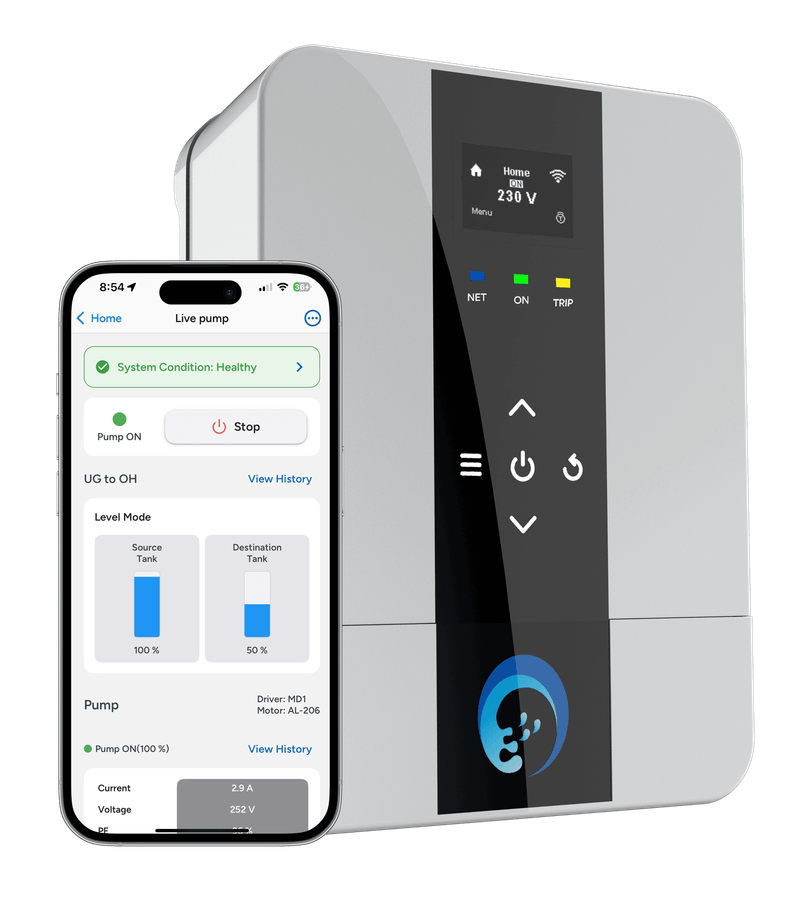
Engineered and built by us — each one the starter, the controller and the protection in a single box.
Questions, answered
DOL, star–delta or VFD — which starter do I need? +
DOL for most pumps up to about 7.5 kW (10 HP): simplest, cheapest, and a short inrush on a small motor bothers nobody. Star–delta for larger motors on light starting loads, or where the electricity supplier caps direct-on-line starting — it starts at roughly a third of the DOL current, then changes over to delta to run. A VFD where the duty varies: it starts within full-load current, holds any speed, makes PID pressure control possible and removes water hammer at stop.
Why does a VFD save energy on a pump? +
Because of the affinity laws. A pump's flow falls in step with its speed, but the power it needs falls with the cube of speed — so a pump held at 80% speed draws roughly half the power. A duty that spends most of its life at part load saves the most.
Does a VFD need a different controller? +
No. The Multi Pump Controller talks to supported Danfoss and Grundfos drives over Modbus alongside APCON drivers, so a drive is one more pump in the set rather than a separate system.
More water automation
Every automation runs on the same APCON controllers — and keeps working without the internet.
Multi-Pump Systems & Duty Rotation
Run two to six pumps as one set: duty rotates so they wear evenly, extra pumps stage in when demand rises, and a healthy pump takes over the moment one trips.
How it is done →Pump Motor Protection
Dry run (with and without a sensor), overload, under load, under and over voltage, phase loss, over-cycling and over-run — nine protections armed on every APCON controller, logged with their cause.
How it is done →Also automated
Want pump starters — dol, star–delta & vfd on your site?
Tell us what your pump room looks like today — we design, retrofit and stand behind the whole system.