

Timer & Scheduler — Irrigation & Fountains
Set it once. It waters the garden and runs the fountain without you.
Irrigation and water features are the two things everyone means to switch on and forget to switch off. A mechanical timer helps until the power blips and it forgets what time it is; a phone reminder helps until the day you travel. A scheduler inside the controller runs the cycle whether or not anyone is home — and knows when there is not enough water to spare.
Irrigation timer · garden watering schedule · fountain automation · water scheduling
What makes it work
The parts of the diagram above that are doing the real work.
MOV zone control
Motorised valves open and close each zone, so the pump does not have to start and stop for every one. One pump holds the line while the controller works down the zones — lawn, then beds, then the fountain — opening each valve for its own run time. Zones with different needs stop fighting over one timer.
Or switch the pump itself
A single-zone garden or a fountain on its own line does not need valves. The same controller simply switches the pump on the schedule, with the same protections armed underneath.
The schedule lives in the controller
Start time, run duration and days per zone are stored in the APCON driver, so they survive an internet outage and ride through a power cut. The app is how you change them and see what ran — never a dependency for the watering itself.
The control logic
Irrigation, fountains and filtration that run to a plan the controller keeps — through a power cut.
- Per-zone start time, run duration and days of the week, set at the panel or from the app
- Cyclic timers — run for N minutes, rest for M — for fountains, filtration and dosing duties
- MOV zone control: motorised valves work down the zones while one pump holds the line
- A real-time clock inside the controller, so the schedule survives an internet outage and rides through a power cut
- Reserve-level veto — a cycle that would take the tank below the reserve you set is skipped and reported
- Run-now, hold-for-rain and per-zone override, without disturbing the schedule underneath
- Every run logged with its duration, so a missed cycle is visible instead of assumed
What you set
- Start time
- Duration
- Days
- Zones / MOV
- Cyclic on / off
- Reserve level
How it is done
Every step below is a retrofit on the system you already have — no replacement pumps, no civil work.
- 1
Set the schedule from the app
Start time, run duration and the days of the week, per zone. Change it from anywhere — a schedule set from the airport takes effect at home before you land.
- 2
The controller keeps the time
The schedule lives inside the APCON controller, so it survives an internet outage and rides through a power cut without forgetting what day it is.
- 3
Skip the cycle when water is short
The scheduler reads the same tank level the rest of the system does. Below the reserve you set, the cycle is skipped and you are told — drinking water is never spent on the lawn by accident.
- 4
Override and review
Run a zone now, or hold the schedule while it rains, straight from the app. Every run is logged with its duration, so you know the garden was actually watered while you were away.
What it takes
- APCON smart controller driving the irrigation or fountain pump (or a solenoid valve per zone)
- Tank level sensor, so a low tank can veto a cycle
- The Devyami app for schedules, manual override and run history
What you get
- Gardens watered on schedule whether or not anyone is home
- Fountains that run during visiting hours and stop after them
- No cycle run on an empty tank — the reserve you set is respected
- Every run logged, so a missed cycle is visible instead of assumed
Controllers that do this
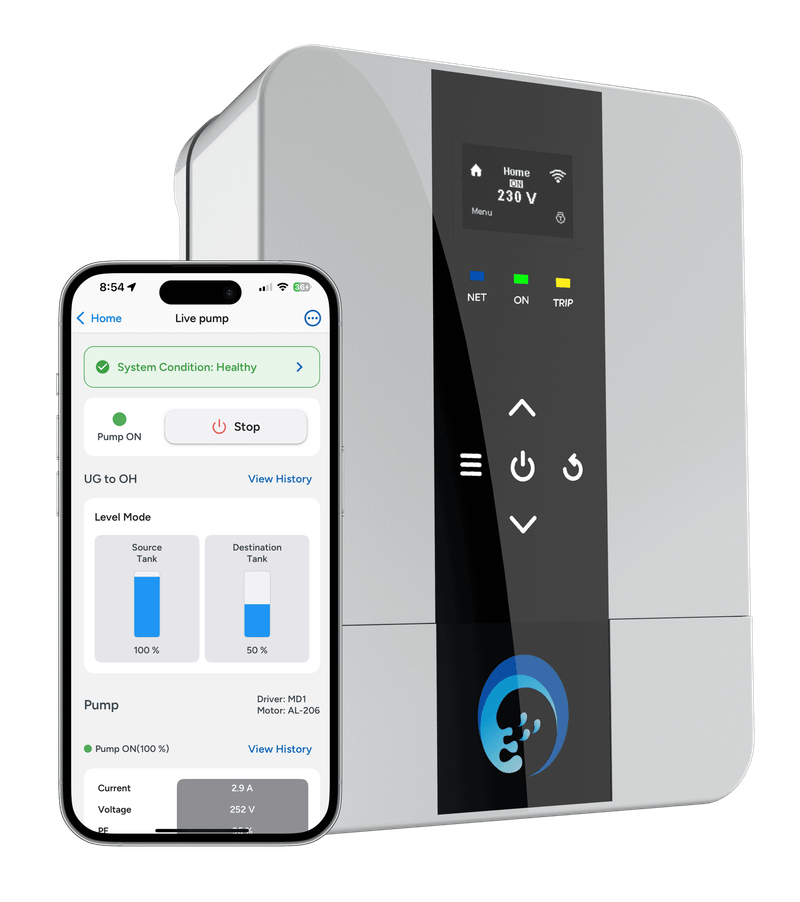
Engineered and built by us — each one the starter, the controller and the protection in a single box.
Questions, answered
Will my irrigation schedule survive a power cut or internet outage? +
Yes. The schedule is stored inside the APCON controller, not in the cloud, and the controller keeps time across a power cut. The internet is only how you change the schedule and see the history.
Can the fountain and the garden run on different schedules? +
Yes — each is its own zone with its own start time, duration and days. A fountain that runs through the evening and irrigation that runs at dawn are two schedules on the same system.
What stops the system watering the garden when the tank is nearly empty? +
A reserve level you set. The scheduler reads the tank the same way the pump automation does, and a cycle that would take the tank below your reserve is skipped and reported rather than run.
More water automation
Every automation runs on the same APCON controllers — and keeps working without the internet.
Tank automation — single & multi-tank
Two ways to read a tank — non-contact ultrasonic on the lid, or a contact hydrostatic level transmitter hanging in the water. Both report live percent and litres, warn you before an overflow or an empty tank, and feed the same reading the controller switches your pumps on.
How it is done →Pressure automation — HPN, PID & VFD
Hydro-pneumatic (HPN) systems keep constant pressure across a whole building: pumps cascade in as demand rises, each start goes to the pump with the fewest starts so the set wears evenly, and a pump that trips is covered by the next. A pressure transmitter on the header puts live line pressure in the app — which pumps are running, pressure trends and every changeover.
How it is done →Hot water circulation & heat pump control
A monitored circulation loop keeps hot water at every tap the moment it opens — no running the shower cold for a minute. The app watches loop temperature, runs the circulation pump only when needed, and coordinates heat pumps and geysers so comfort never fights efficiency.
How it is done →RO controller
The RO plant’s own numbers on your phone: raw, treated and reject TDS, pH and ORP, flows, the pressures either side of the membrane, and every pump, switch and tank float — with an alert the moment something trips.
How it is done →Water batching control
Digital flow meters turn every pipeline into a number you can manage: litres pumped today, consumption per wing or per site, and totals you can export. Water metering is also your leak detector — flow at 3 AM when everyone is asleep is a leak announcing itself.
How it is done →Multi-pump controls
Run two to six pumps as one set of equals: each start goes to the pump with the fewest starts so they wear evenly, extra pumps stage in when demand rises, and the next pump takes over the moment one trips.
How it is done →Pump controls — DOL, star–delta & VFD
DOL, star–delta or a variable frequency drive: how each one starts a pump motor, the starting current it draws, and which one your pump needs — with automation and protection on top of every one.
How it is done →Motor protection
Dry run (with and without a sensor), overload, under load, under and over voltage, phase loss, over-cycling and over-run — nine protections armed on every APCON controller, logged with their cause.
How it is done →More in Smart Water IoT App
Want timer & scheduler — irrigation & fountains on your site?
Tell us what your pump room looks like today — we design, retrofit and stand behind the whole system.